
BULK MATERIAL CONVEYING / EQUIPMENT COMPARISON
When planning a dry bulk material handling system, the choice between a chain drag conveyor and a screw conveyor can affect layout, material handling, maintenance and how the equipment connects to the rest of the process. Both use mechanical movement to convey suitable bulk solids, but they do so in different ways.
This guide compares their operating principles, common applications and selection considerations. It is a starting point for evaluating equipment—not a substitute for reviewing the actual material and operating conditions.
Understanding Chain Drag and Screw Conveyors
A chain drag conveyor moves bulk solids using a driven chain and flights through an enclosed conveying path. A screw conveyor moves material using a rotating helical screw inside a trough or tube. Either may be appropriate for a given duty, depending on the material, route, capacity and process constraints.
How Chain Drag Conveyors Work
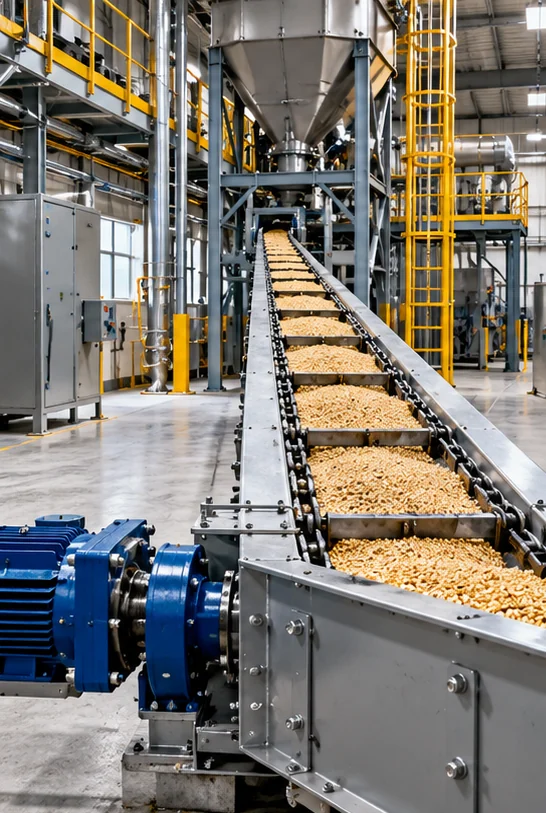
A drive moves a chain fitted with conveying flights through a housing. The flights advance material toward a discharge point. The enclosure, chain path, inlet and discharge design must suit the application. Chain drag conveyors are often considered where an enclosed mechanical conveying path is desirable.
Key Components and Operating Features
- Chain and flights: Provide the mechanical movement that carries material through the housing.
- Housing and wear surfaces: Contain the conveyed product and must be designed with material abrasion, dust and service access in mind.
- Drive, tensioning and discharge: Influence equipment operation, maintenance and the interface with upstream and downstream machinery.
How Screw Conveyors Work
A screw conveyor rotates a helical flight to advance material along a trough or enclosed tube. Screw diameter, pitch, speed, inclination and the properties of the conveyed material affect its operation. Screw conveyors may be used for conveying, feeding or transferring suitable bulk solids, provided the design matches the required duty.
Key Components and Operating Features
- Helical screw: Advances material along the conveying path as it rotates.
- Trough or tube: Contains the material and supports appropriate loading, discharge and cleaning arrangements.
- Drive, bearings and seals: Require attention to operating duty, material intrusion, accessibility and maintenance.
Common Industrial Applications
Transferring Dry Bulk Materials Between Process Steps
Both conveyor types may be evaluated for moving compatible powders, granules and other bulk solids between storage, processing and discharge equipment. The material’s flow behavior, particle size, moisture content, abrasiveness and tendency to compact or bridge are important.
Enclosed Conveying in Dust-Sensitive Areas
Enclosed mechanical conveyors can help contain material within a defined path. However, actual dust control depends on the design of the housing, seals, transfer points, dust collection and operating practices. Neither equipment type should be assumed dust-free without reviewing the complete installation.
Key Benefits and Engineering Considerations
- Material compatibility: Evaluate flowability, abrasion, friability, particle size, moisture and temperature. Some materials may require testing.
- Conveyor route: Confirm horizontal distance, inclination, inlet locations, discharge points and available footprint. Avoid assuming that either technology suits every route.
- Capacity and duty: Specify required mass flow, operating hours, starts and stops, and expected variations in material supply.
- Dust and housekeeping: Review sealing, inspection openings, transitions and the need for extraction or containment.
- Maintenance: Consider chain and flight wear, screw and trough wear, bearings, drives, inspection and replacement access.
Comparing Chain Drag and Screw Conveyors
| Selection factor | Chain drag conveyor | Screw conveyor |
|---|---|---|
| Conveying principle | Chain and flights move material through a housing | Rotating helical flight advances material through a trough or tube |
| Material considerations | Assess chain/flight interaction, wear and product behavior | Assess screw/material interaction, wear, compaction and product behavior |
| Layout considerations | Housing route, chain path, access and discharge design | Length, screw geometry, inclination, supports and discharge design |
| Maintenance focus | Chain, flights, wear surfaces, drive and tensioning | Screw flights, trough, bearings, seals and drive |
| Integration | Inlet/discharge transitions, controls and inspection access | Feed conditions, inlet/discharge transitions and controls |
This table describes general engineering differences. It does not establish which conveyor has a higher capacity, lower cost or better performance for a specific application.
How to Select the Right Conveyor for Your Material
Start with a representative material description and the operating duty. A preliminary equipment specification should identify bulk density, particle size, moisture content, abrasiveness, required throughput, conveyor distance, elevation change, inlet and outlet geometry, dust-control requirements and maintenance constraints. Consider how the conveyor will be loaded and whether downstream equipment requires a steady feed.
Questions to Ask Before Specifying Equipment
- What is the material, and how does it behave under mechanical movement?
- What average and peak throughput must the conveyor handle?
- What distance, inclination and number of transfer points are required?
- Is containment, cleaning or product integrity particularly important?
- What space is available for drives, inspection and maintenance?
Frequently Asked Questions
Is a chain drag conveyor better than a screw conveyor?
Not universally. Each has different mechanical characteristics. The preferred solution depends on material behavior, route, capacity, operating conditions and maintenance requirements.
Can both conveyor types handle powders?
Both may handle certain powders, but suitability must be established for the specific product. Cohesive, abrasive, fragile or moisture-sensitive powders can require additional engineering review or material testing.
Does an enclosed conveyor eliminate dust?
No. An enclosure may support containment, but dust control also depends on seals, transfer points, pressure conditions, extraction and maintenance.
Additional Conveyor Engineering Resources
For additional technical guidance on screw conveyor design and equipment selection, see the Conveyor Equipment Manufacturers Association (CEMA) Technical Resources. These industry resources can complement an application-specific engineering review.
Conclusion
Chain drag and screw conveyors are both established approaches to moving suitable bulk solids, but they solve conveying duties differently. The strongest selection process begins with the material, throughput, layout and interfaces—not a preference for one conveyor name. Reviewing the complete application helps identify which technology deserves further engineering evaluation.
Considering a chain drag or screw conveyor? Contact Saturn Conveyor with your material details, layout and capacity requirements to discuss suitable options.