

PALLET HANDLING / ENGINEERING GUIDE
Designing a pallet conveyor system starts with an important distinction: will the equipment move loaded pallets, empty pallets, or both? The answer affects conveyor support, transfer arrangements, controls and the choice of pallet handling equipment.
This guide explains how common pallet conveyor technologies work and the questions to resolve before selecting a system for manufacturing, packaging or warehouse operations.
Understanding Loaded and Empty Pallet Conveying
Loaded pallets carry goods that may vary in mass, height, stability and weight distribution. Empty pallets are lighter, but can present their own challenges, including uneven boards, damaged runners and inconsistent construction. Conveyor selection must account for the full range of pallet types and operating conditions.
A complete pallet handling process may include powered conveyor sections, direction changes, accumulation, pallet dispensing or stacking, and integration with palletizing or other production equipment.
How Pallet Conveyor Systems Work
Chain-Driven Live Roller (CDLR) Conveyors
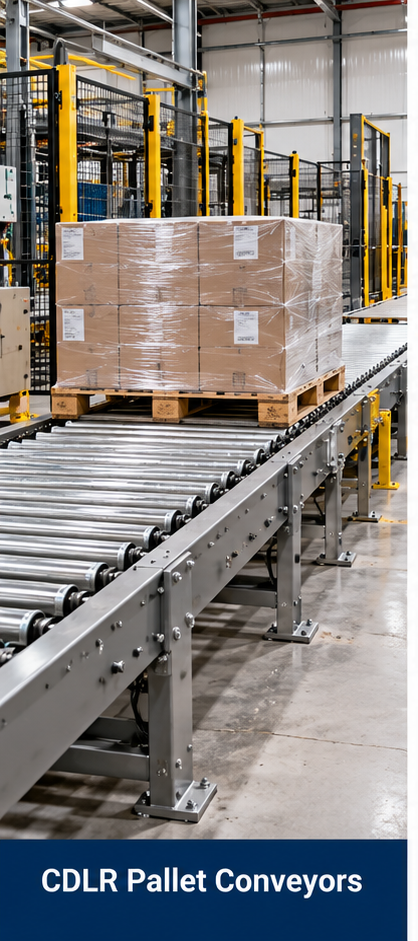
CDLR pallet conveyors use driven rollers to move compatible pallets or unit loads. Roller spacing, load capacity, pallet bottom construction and transfer interfaces must be selected for the specific application. Pallets need adequate support throughout travel and at transfers.
Chain Strand Pallet Conveyors
Chain strand pallet conveyors support and move pallets using driven chains. The number and spacing of strands must match the pallet’s support surfaces and orientation. Chain strand systems may be evaluated when the pallet base and required movement are compatible with chain support.
Pallet Turntables
Pallet turntables rotate a pallet or the conveyor section supporting it to change orientation or conveying direction. They require consideration of pallet dimensions, load stability, positioning accuracy and safe interface with adjacent conveyor sections.
Pallet Dispensers and Stackers
Pallet dispensers and stackers support automated supply or collection of compatible empty pallets. Pallet consistency, stack height, separating mechanisms and equipment guarding are important design considerations.
Common Industrial Applications
Loaded Pallets Leaving a Production Line
Conveyors can transfer completed pallet loads from palletizing toward inspection, wrapping, storage or shipping processes. Engineering must account for maximum load, pallet footprint, center of gravity, transfers and downstream equipment interfaces.
Empty Pallet Supply to Palletizers
An empty pallet conveyor and dispenser may provide pallets to an automated palletizing operation. The design must accommodate pallet dimensions, condition, feed sequence and reliable presentation at the receiving station.
Empty Pallet Return and Stacking
Empty pallets may be returned for reuse or collected in stacks. The conveying route, pallet orientation and stacker compatibility should be checked, particularly where different pallet designs are used.
Key Benefits and Engineering Considerations
- Pallet construction: Identify bottom boards, runners, stringers, deck gaps and permitted conveying orientation.
- Load characteristics: Record empty and loaded weights, load distribution, overall dimensions and stability.
- Throughput: Define pallets per hour, peak arrival rate, accumulation needs and required spacing.
- Transfers and direction changes: Confirm support continuity and the compatibility of rollers, chains and turntables.
- Safety and maintenance: Evaluate guarding, access, controls, sensors, jam recovery and service clearances.
Comparing Pallet Handling Equipment
| Equipment | Primary function | Selection considerations |
|---|---|---|
| CDLR conveyor | Moves compatible pallet loads on driven rollers | Pallet bottom support, roller spacing, load and transfers |
| Chain strand conveyor | Moves pallets supported on driven chains | Runner orientation, chain spacing, load and transfers |
| Turntable | Changes pallet orientation or direction | Rotation clearance, load stability and controls |
| Dispenser / stacker | Supplies or collects compatible empty pallets | Pallet consistency, stack height and separation |
Equipment may be combined into one handling line. Suitability depends on the actual pallets and operating requirements rather than the equipment category alone.
How to Select the Right Pallet Conveyor System
Begin with representative pallet drawings or samples, the maximum and minimum load weights, dimensions and the required flow through the plant. Identify whether pallets will travel lengthwise or crosswise, where they must stop or turn, and whether empty pallet storage or dispensing is needed.
Questions to Ask Before Specifying Equipment
- What pallet types, dimensions and bottom constructions will be handled?
- What are the minimum and maximum load weights and dimensions?
- How many pallets per hour must move through the system?
- Where are the transfers, turns, accumulation zones and operator access points?
- How will the equipment interface with palletizers, wrappers, forklifts or other machinery?
Frequently Asked Questions
Can one conveyor handle both empty and loaded pallets?
It may be possible when the equipment is designed for the complete range of pallet construction, dimensions and load weights. The lightest and heaviest operating cases both need review.
When should I consider chain strand instead of CDLR?
Compare the pallet’s bottom support surfaces, orientation and transfer requirements. The most suitable conveying method depends on how the pallet can be safely and reliably supported.
Do I need a pallet dispenser?
A dispenser may be useful when a process requires a controlled supply of empty pallets. The decision depends on the palletizing process, available floor space, pallet consistency and required throughput.
Conclusion
Reliable pallet handling begins with understanding the pallet itself. Loaded and empty pallets place different demands on support, transfer and automation equipment. A coordinated review of pallet construction, loads, throughput and plant interfaces helps determine the appropriate combination of conveyors and handling devices.
Planning a loaded or empty pallet conveying system? Contact Saturn Conveyor to review your pallet specifications, layout and handling requirements.